Physics 406: Introduction to Modern Astronomy, Lab Info
Sheet
-
Lab Assistants: TBA, 3rd floor
DeMeritt Hall (Grad Stud area) Lab Groups 1, 2
-
TBA, 3rd floor DeMeritt Hall (Grad Stud
area) Lab Group 3,4
-
Lab Room: DeMeritt 253
-
Lab Times:
The first labs will be held the week of September 4.
Indoor labs begin promptly at 6:10 pm or 8:10 pm. If it looks clear or only
partly cloudy, we are likely to go outside, so arrive early (i.e. on the hour)
for outdoor labs. If you arrive on your scheduled lab night and time and we
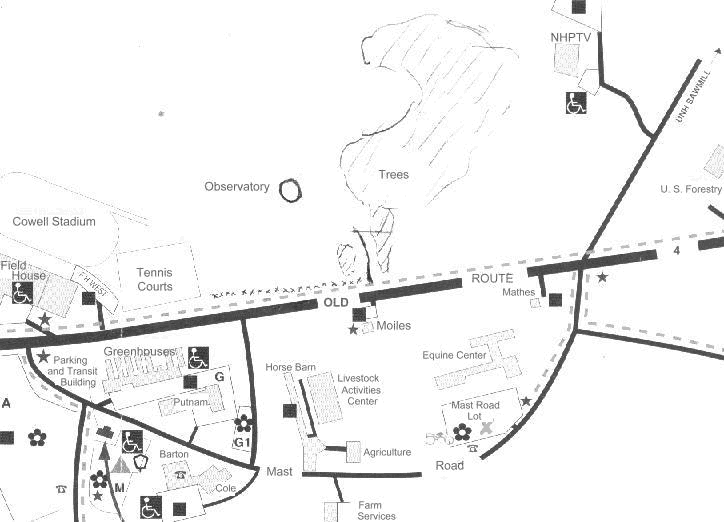
are not there, we've left for the observatory. A map showing its location, behind the UNH horse barns,
is on the physics 406 bulletin board. If you arrive late, be sure to check in
as we will be taking attendance. Please refer to the Lab Schedule if you are
unsure when your Group meets and what is planned.
Required Work: Complete Lab work contributes to 30% of your overall
grade, which works out to 2.7% of your total grade per lab. There will be eight
or nine indoor labs, the planetarium
visit, and at least one, hopefully two (weather permitting) outdoor
labs and/or the Radio Telescope lab. You are expected to read the labs and
recommended readings ahead of time. Bring your a calculator to each indoor lab.
You will need a pencil, paper, and a hard surface for sketches for the outdoor
lab.
PDF-Files of Lab Manuals:
They can be found under "Documents" on the Blackboard
site. They will appear as we go.
Discussion vs. Copying: While discussion of the lab with your partner
and other classmates is encouraged, wholesale copying is not and will be penalized.
In such cases, we typically divide the grade evenly between the copiers. Your
final responses should be your own. Plagiarism and academic fraud is seen as
a serious offence by the University.
Grading: Each lab will be graded on a ten point scale. Thoughtfulness
of response and contributing calculations may count towards partial credit,
although there may be little opportunity for this, as most of the labs are broken
down step by step. Neatness counts! If we can't read it, we can't grade it.
Be on time!!
Make-up Points:
We would like everyone to earn perfect scores on at least 8 out of 10
labs; however, this will not always work out. If you are unsatisfied with
your lab grade, you may earn back up to half of the lost points in an
indoor lab or up to three-quarters of the lost points of the outdoor lab
by going through the lab again with your TA during office hours or by
appointment. For outdoor lab make-ups, you will be expected to rewrite
the sections where you lost the points, but only after conferring with
your TA. These make-ups should be done as soon as possible after
receiving the graded lab, while the material is still fresh in your
mind.
Make-up Labs:
Due to various scheduling constraints, these are very, very difficult
to arrange, and require a good excuse. Still, if you have one, we will do
what we can to accommodate you. It is your responsibility to seek
out a make-up lab. Typically, we will try to put you into another section
doing the lab that you missed. We may also run a few make-up labs towards
the end of the term.
Due Dates: All indoor labs are due at the end of that night's lab
session. The outdoor lab requires som additional research and will be due two
weeks later at the next lab. At the end of the semester such labs should be
placed in your TA's mailbox.
Late Policy: Each day late costs 2 points! Three quarter credit
will be given if a lab is up to a week late. After that it will be given half
credit. No labs will be accepted after the day of the Final
Exam. Notify your TA immediately if you have extenuating circumstances.
Late labs should also be placed in your TA's lab report bin.
Outdoor Labs:
You should be prepared to go out on any lab night. Weather in New
Hampshire can be fickle, so we'll take advantage of it when we can, and it
can change from the afternoon to evening. Dress warmly! You are going to
be standing around outside in the cold for nearly two hours, so you'll
have a lot longer to appreciate the cold than walking between classes.
Also, the temperature can drop 20 degrees or more at night. We advise
wearing multiple layers, as well as a hat and appropriate footwear: we
have to tromp through the field to get there. Be sure to have pencil,
paper, and a hard surface for sketching. When writing the report, Kuhn is
a good resource, but need not be the only resource for all of your
responses. If you want to see more of the observatory, you may wish to
attend one of the open nights
offered twice a month.
Course
Papers: The main guidelines for writing the outdoor lab reports
are found in the Lab
Manual, but you may benefit from this additional advice. This is a science
course, not a history, art, or philosophy course, so, while historical information,
description of what you have seen, and philosophical insights may serve to put
the subject of your paper into context, the bulk of your report should be science-oriented.
By science-oriented, we mean that we are looking for both descriptive information
about the object, theorem, or phenomenon, as well as justifications for that
information. How do we know what we know, and why do we believe what we believe?
This kind of material should dominate the paper, and should, on its own, fulfill
the page requirements. Even well-written papers which do not include such justification
can earn no more than a B. Justifying your assertions in a scientific paper
is just as important as in a literary or historical paper.
If you find yourself having to enlarge the font size, play with margins, or
repeat your points in order to meet the page requirements (remember, your TAs
were students once, too!), you probably need to do more research or ask for
advice.
Proofread! Proofread! Proofread! Have a friend read your paper to make
sure that it is clearly written and understandable, as well as
grammatically sound. This should also help you catch places where you
haven't defined jargon. Assume your reader is intelligent, but hasn't
necessarily taken an astronomy class.
The UNH Writing
Center is another valuable resource for advice on writing papers.
Chris Siren/Eberhard Moebius